Created and Published in the Spring of 2025
When Annie Tiffany Mitchell and Alfred Mitchell began assembling the sprawling harborside estate that would a half-century later become the campus of Mitchell College, they brought with them a diverse domestic staff. Two of these staff members were Benjamin Franklin Coles and his wife Harriet “Hattie” Coles. Although they experienced tremendous hardships in their early lives, Benjamin and Hattie Coles achieved a measure of financial security, raised a family, and earned the respect of their fellow citizens during their years in New London.
Annie Olivia Tiffany was the daughter of jeweler Charles Lewis Tiffany and his wife Harriet Young Tiffany. Annie’s brother was the world-renowned designer Louis Comfort Tiffany. As an heiress to the Tiffany fortune, she had the means to pursue a lavish lifestyle, but she was more drawn to the natural world than the material one.
Alfred Mitchell was the son of a prominent Norwich, Connecticut minister. As a young man, he travelled the world during his business ventures in whaling, gold mining, and guano harvesting. He served honorably during the Civil War in the 13th Connecticut Regiment. Despite the objection of Annie’s family to her relationship with Alfred Mitchell, who was more than ten years her senior, Annie saw in Alfred a keen mind and adventurous spirit which complemented her own intellectual qualities and personal interests.
The couple was married on April 27, 1871, and moved to a Manhattan apartment. Daughter Alfreda was born in 1874 followed by daughter Charly in 1877. The birth of their children motivated Annie and Alfred to begin planning for a move “out to the country.” Beginning in late 1879, Alfred Mitchell purchased several large parcels of land along Pequot Avenue in New London, including the Jonathan Rogers and S. K. Mason properties. The Mason parcel included the gambrel roofed colonial home that is now the lower section of Mitchell Hall. Alfred and Annie immediately began an ambitious expansion and beautification of the estate.
By June 1, 1880, Alfred and Annie Mitchell and their two young daughters were residents of Pequot Avenue in New London. In the 1880 census, the occupation of Alfred Mitchell was listed as “farmer” and Annie as “keeping house.” Among the domestic staff living at the property with the Mitchells were 45-year-old Benjamin Coles and 30-year-old Harriet Coles. The occupation of Benjamin was “farm servant” and Harriet was listed simply as “servant.” The race of both Benjamin and Harriet was noted as “mulatto.”
Benjamin F. Coles
Benjamin Franklin Coles was born about 1835 in East Hampton, New York. He was the son of Silas Coles and Synta Rogers. Silas Coles was among the many African American and Native American residents of Eastern Long Island involved in the whaling trade. Crew lists show that Silas Coles sailed out of Sag Harbor, Long Island between 1828 and 1838. Census records show that Silas Coles lived in the Freetown section of East Hampton and his race was listed as black. Freetown was a neighborhood populated by freed slaves and their descendants. Many of the residents of Freetown worked as whalers. Others were servants in the homes of wealthy East Hampton families, often the same homes where their parents had served as slaves. Little information is known about Benjamin’s mother, Synta Rogers, but family oral history suggests that she was multi-racial, with Shinnecock Indian, white, and perhaps also African American heritage. The mixed race of Synta Rogers is consistent with Benjamin’s Coles’ identification as mulatto in the 1880 census.
As a young man, Benjaman F. Coles was also a whaler, most likely sailing with his father out of Sag Harbor. His occupation is listed as “sailor” on both his 1863 Civil War draft registration and the 1865 State of New York Census. Although Coles registered for the draft, there is no record of his service during the Civil War. Following the war, with the whaling industry in steep decline, Coles began working as a laborer for prominent East Hampton farmer, Jeremiah Mulford. In addition to his farming operations, Mulford rented rooms to summer beachgoers. Many years later, Mulford’s daughter recollected, “After breakfast everyone went to the beach. Some walked, others rode in our big stage driven by colored Ben Coles.” Other recollections mention Coles playing the fiddle at dances organized for summer vacationers.
In 1867, Benjamin Coles married Hannah A. Pharoah, a daughter of Stephen “Talkhouse” Pharoah. Pharoah was a Montaukett Indian who served briefly as leader of the tribe, and who was in his later years exploited by P. T. Barnum as the “Last of the Montauk Kings.” Indian Field was a small part of eastern Long Island which had been reserved as a living place for the dwindling Montaukett Indian population. As a matter of economic survival, intermarriage between the residents of Indian Field and the residents of Freetown increased during the mid-19th Century. Benjamin Coles had three daughters with Hannah Pharoah, namely Mary in 1868, Kate in 1869, and Hannah in 1872. They lived in Freetown. Sadly, his wife Hannah Pharoah Coles died of tuberculosis in April of 1874.
Harriet Anna Florence “Hattie” Alexander
Harriet Anna Florence Alexander was born to James Alexander and Hannah Clayton in Orange County, Virginia in April of 1852. Harriet was generally known by her nickname, “Hattie.” She was born into slavery, as was her mother, and her grandmother. Hattie’s older brother, also named James Alexander, was born about 1841 and was a Civil War veteran. Hattie’s father died young, and her mother Hannah Clayton remarried a man named Peter Walker, also of Orange County, Virginia, on April 7, 1866.
Hattie was part of a large group of former slaves from Virginia and other southern states who migrated to New York during the 1870s. Both Hattie’s 1879 marriage to Benjamin Coles and her 1880 adult baptism were performed in New York by Reverend Daniel Wisher. Wisher, also a Virginian, was instrumental in the establishment of New York’s historic Mount Olivet Baptist Church. He was the church’s first minister, and in 1878 oversaw its formal establishment in the Chelsea section of Manhattan. Mount Olivet subsequently moved to Harlem in 1925. A residence address very near to the original Mount Olivet Church was provided on Hattie and Benjamin’s December 1879 application for a marriage license. Reverend Wisher often assisted his parishioners in securing employment. He owned a number of coaches and often leased them out, with drivers, to wealthy New York families. He also assisted women in securing positions as domestics with these families.
Benjamin and Hattie Coles 1878 – 1880
The years 1878, 1879, and 1880 were particularly eventful for Benjamin Coles and Hattie Alexander. In June 1878 Benjamin’s 6-year-old daughter Hannah A. Coles died of hip disease. This was followed by the death of 9-year-old Kate in February 1879 and 11-year-old Mary in October 1879. The latter two daughters died of tuberculosis.
Steven “Talkhouse” Pharoah, the father-in-law of Benjamin Coles, died in late August 1879, also from tuberculosis. The death of Steven Pharoah paved the way for the October 22, 1879 sale to a New York developer of all remaining rights in the Montauk ancestral lands. Two centuries earlier, the Montauks had sold their land to the white settlers of East Hampton, but they retained the right to graze their cattle, hunt, and fish upon the land, and to continue to live in Indian Field. Steven Pharoah was born at Indian Field in 1822. In 1879 he was buried there, in the same Montauk Indian burial ground where his daughter and grandchildren (the wife and children of Benjamin Coles) had just recently been buried. To the extent that Benjamin F. Coles had become immersed in the Montaukett culture, the loss of his entire family, the death of Steven Pharoah, and the sale of the Montaukett land, left Benjamin without any lingering connection to it.
Given the rapid changes Benjamin Coles was experiencing, it is no surprise that his life began to move in a new direction. He sought employment in New York City after his wife Hannah’s death, and appears to have been working as a coachman for Annie and Alfred Mitchell by 1878. He met Hattie Alexander during that same period. Beginning in May of 1879, a series of advertisements that appear to have been published by Benjamin Coles were printed in the “Positions Wanted” section of the New York Times. An example of these appeared on May 22, 1879 and states as follows: “COACHMAN AND GARDNER – By a respectable colored man: City or Country: Best References. Address Alfred Mitchell. No. 311 West 42nd St.” A similar solicitation appeared on May 31, 1879, and then another similar series were printed between March 9 and March 19, 1880. The most plausible explanation for these advertisements is that the Mitchell’s, having decided that they would soon leave Manhattan for New London, were assisting Benjaman Coles in finding a new position.
Hattie Alexander gave birth to a son Benjamin on July 28, 1879. No birth record has been found, but subsequent vital records confirm that Benjamin Franklin Coles was the child’s father. Hattie Alexander and Benjamin Coles were married in Manhattan on December 3, 1879.
Although Benjamin Coles was still seeking a new position as of March 19, 1880, an employment arrangement must have been worked out with Benjamin and Hattie Coles and the Mitchells. When the 1880 United States Census was released with a June 1, 1880 enumeration date, Benjamin and Hattie Coles are noted to be employed by and living with the Mitchells at their property on Pequot Avenue, New London, Connecticut.
Notably absent from the Mitchell residence as of June 1, 1880, is the Coles’ newborn son, Benjamin, who would have been just ten months old at the time. Census records show that young Benjamin was at that time living in Freetown, Long Island with a 60-year-old native American woman named Eliza Cooper and several other children. Eliza Cooper was the aunt of Benjamin’s first wife Hannah Pharoah. She appears to have served as a caregiver for several children of others. The decision of Benjamin and Hattie to leave their son in another’s custody must have been gut-wrenching but it was, perhaps, a condition of employment with the Mitchells in New London. It is doubtful that the Mitchells could have accommodated a newborn within their home upon first moving to New London.
On October 4, 1882, Benjamin F. Coles purchased a home at 14 Keeney Lane, New London, that abutted the Mitchell estate. The move to their own home enabled Benjamin and Hattie to bring young Benjamin to New London while continuing to work for the Mitchells. A New London directory shows that Hattie’s mother also came to live with them, and presumably assisted with the care of Benjamin. Benjamin attended the Harbor School, a New London grammar school that was originally located on Pequot Avenue. Despite the early separation from their son, it is impressive that Benjamin and Hattie Coles were able within a short period of time to purchase their own residence and make suitable arrangements to bring their son to New London. It is unlikely they would have been able to achieve home ownership so rapidly without the receipt of reasonable wages from the Mitchells.
City of New London vital records reveal that on April 26, 1883, a second child, Alice G. Coles, was born to Hattie and Benjamin. She was followed by Edward A. Coles in 1888 and Walter A. Coles in 1891.
In an episode that appears to be completely out of character for Hattie Coles, an October 2, 1893 article in the New London Day reveals that she was arrested for public intoxication and sentenced to 30 days imprisonment. There were no other similar incidents reported between 1880 and 1900, the period that she resided in New London. The 30-day sentence was severe for the offense, and others convicted for the same offense in the same court session, were given far lighter sentences. The arrest is less surprising when it is viewed in its historical context. New London vital records reveal that five-month-old Alice Coles, the daughter of Benjamin and Hattie Coles, died of bronchitis earlier the same day as Hattie’s arrest.
With the exception of that one episode, the lives of the members of the Coles family during their twenty years in New London were exemplary. New London annual directories confirm Benjamin and Hattie continued to live at 14 Keeney Lane throughout the remainder of the 1880s and 1890s. Benjamin’s employment is listed as “laborer” and Hattie as “laundress.” There is no confirmation in the directories that they continued to be employed by the Mitchells, but that appears to be the case given their proximity to the Mitchell estate and the nature of their employment. Unfortunately, the 1890 United States Census, which would have provided detailed information about the Coles family during this period, has been destroyed by fire.
New London Day archives include several articles that provide a glimpse into the lives of the Coles family. Benjamin F. Coles appears as one of five public endorsers of a liquor license application filed in 1892 by John Meade, which is an indication of Benjamin’s respected social status. In 1889, Benjamin won first place at the New London County Fair for his entry of a 150-pound mammoth squash. Meanwhile, young Benjamin Coles was an outstanding student at the Harbor School. In May of 1894, he was selected to present a recitation entitled, “What We Plant” at the annual Arbor Day celebration.
On November 1, 1898, Hattie Coles gave a lecture at New London’s prestigious Allyn Hall. The advertisements in the New London Day indicate that the topic of the lecture was slave life in the antebellum south. The notices indicate that Hattie was a former slave, as were her mother and grandmother. The admission price for the lecture was twenty-five cents. The notices for this lecture not only confirm that Hattie was born into slavery. The fact that she was asked to present this lecture indicates that Hattie was locally respected.
In 1898, the Mitchells began arranging for a two-year trip to Hawaii and other extended trips abroad. Their absence would reduce the need for a large staff at the Pequot Avenue estate. By the time of the 1900 Federal Census, the Coles and their sons were all living in New Haven. Young Benjamin was married to Elizabeth Steele on November 25, 1903, but died of pythiosis, a rare tropical blood disease, on October 29, 1904. He left no children. Sons Walter and Edward subsequently married and raised large families.
Hattie Coles died on September 17, 1907 and Benjamin Franklin Coles died three months later on December 19, 1907. They are buried in New Haven’s Evergreen Cemetery. Many of their descendants remain in the New Have area.
Researched, written, and edited by the students of the course entitled, “New London Stories,” Christopher Kervick, Instructor, Mitchell College, Thames at Mitchell, Spring Semester 2025. Samuel Clay, Tyrell Jorden, Jack Levering.
Bibliography
1. Matthews, Christopher N. and McGovern, Alison Manfra, Created Communities: Segregation and the History of Plural Sites on Eastern Long Island, Society for Historical Archaeology, 2018.
2. McGovern, Alison Manfra, Disrupting the Narrative: Labor and Survivance for the Montauketts of Eastern Long Island, 2015.
3. New York Census: 1855, 1875.
4. United States Census: 1820, 1850, 1860, 1870, 1880, 1900, 1910, 1920, 1930, 1940, 1950.
5. New London Vital Records
6. New London Land Records.
7. New Haven Vital Records.
8. Wrighton, Scott W., The Pacific Guano Rush, University of Hawaii, 1983.
9. B.F. Coles Draft Registration, ancestry.com.
10. Adams, Betty Livingston, Black Women’s Christian Activism: Seeking Social Justice in a Northern Suburb, NYU Press, 2016, Project MUSE. https://muse.jhu.edu/book/49201.
11. Transcript of Lecture Delivered by Gaynell Stone, Ph.D., The Material History of the Montaukett, January 31, 1998.
12. On This Site – Native Long Island, https://nativelongisland.com.
13. The North Star, Volume 2, Number 1, Sylvester A. Johnson, Union Theological Seminary (Fall 1998).
14. Archives of the New London Day, New York Times, New York Herald, New York Tribune, Brooklyn Eagle, East Hampton Star, Kings County Rural Gazette, Long Island Traveler, Sag Harbor Express, South Side Signal, Chicago Daily Eagle, Chicago Tribune, Hartford Courant, Connecticut Mirror, Litchfield Enquirer, Norwich Courier, Lancaster Intelligencer Journal, Norfolk Virginian,
15. In-Person Interviews Frederick Coles, Deborah Coles, and Frank Douglass, Jr., great, grand-grandchildren of Benjamin and Hattie Coles and with Kelly Coles, great, great, granddaughter of Benjamin and Hattie Coles.
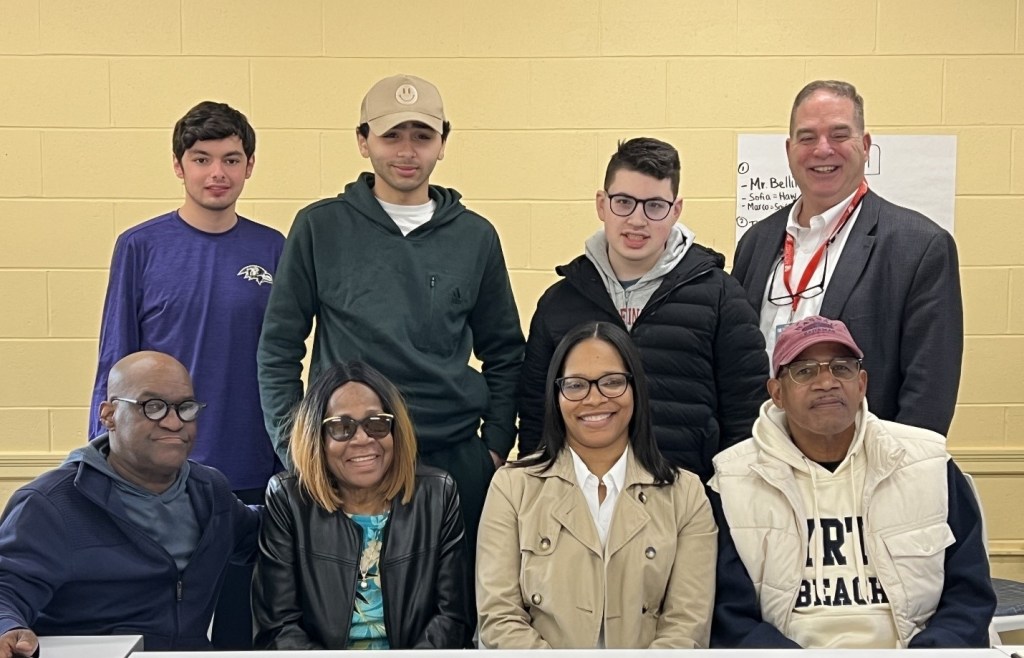
Figure 1 Students of the New London Stories Class at Mitchell College with descendants of Benjamin and Harriet Coles.

 Thames at Mitchell Blog
Leave a comment