Background of Thames at Mitchell:
The Thames at Mitchell program is a holistic program that integrates academic and social learning courses and supports. It is designed to be informative, responsive, and individualized. Utilizing the CASEL Standards, the staff at Thames facilitates student learning in the areas of self-awareness, self-management, social awareness, relationship skills, responsible decision making, executive functioning, and academics. The Thames at Mitchell program’s ultimate goals are to cultivate independence in the college arena and develop leadership skills.

Thames at Mitchell College (Thames) is accredited under Mitchell College and is under the Connecticut State Department of Education as Thames Academy (prior name). Thames is not considered a “Special Education” program but a college transition program, a college pre-freshman year.
Thames Required Academic Courses for all students:
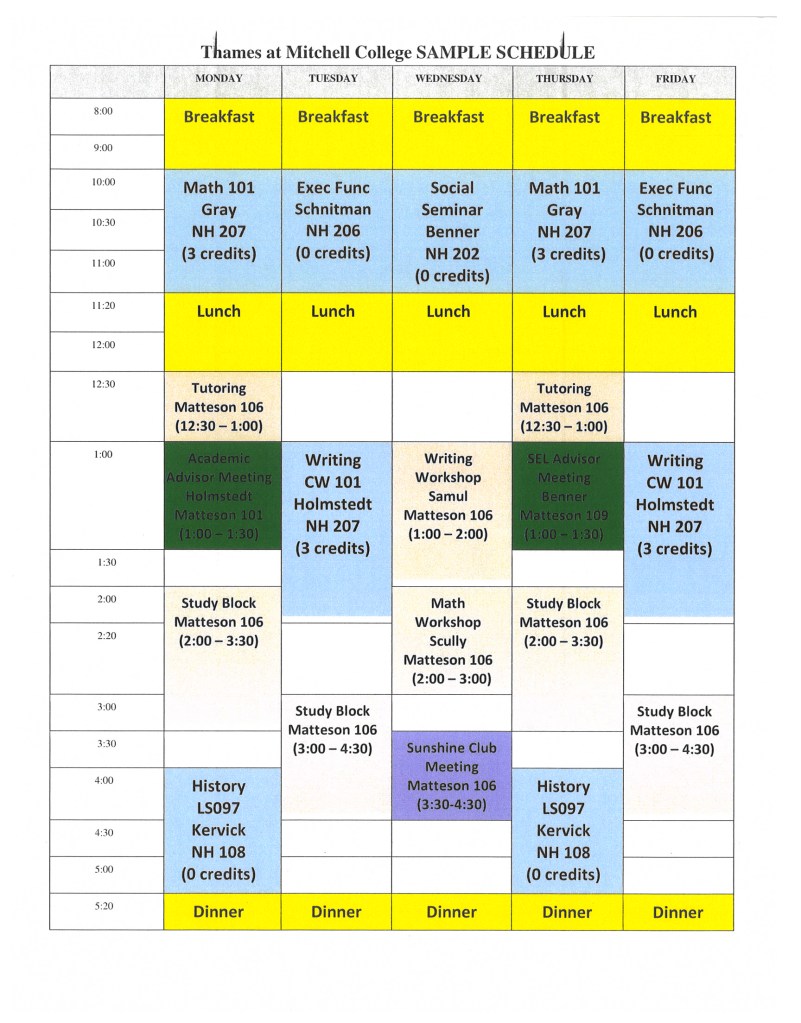
Students take five classes per semester, which consist of a balance of credit and non-credit classes. The student course schedule is designed to look like a freshman schedule. This schedule enables students to practice the intensity of being a freshman and to learn the study skills necessary to be a successful college student. All students take writing, mathematics, executive functioning, and social seminar classes. In addition, students also take electives (non-credit), for example, Script to Stage, History of New London, and Information Technology.
Placement in Courses: All credited courses that students take are applied toward earning an associate or bachelor’s degree. Recommendation of college credited courses for the fall semester is dependent upon standardized test results gleaned from educational evaluations used during the admission process and performance in high school. For the spring semester, placement depends on performance during the Thames fall semester.
Writing: Introduction to College Writing, CW 100 (3 credits): Introduces students to the prerequisite skills for writing, reading, and thinking skills that are necessary for success in college and emphasizes composition processes, writing for different purposes, reading, and responding critically, and conventions of formal written English. CW 101 (3 credits): Assignments emphasize composition processes, writing for different purposes, reading, responding critically, and conventions of formal written English. This is a writing intensive course requiring students to submit a total of fifteen pages of revised and edited text in finished form.
Mathematics: The Math Experience, MA097 (Non-Credit): The Math Experience provides students with an understanding of the fundamentals of mathematics using a real-world approach. The course emphasizes foundational skills and applied project work. The focus will be with project-based learning where students will work with partners or in groups to solve multi-step problems. Content includes: overcoming math phobia, how to “study” mathematics, mathematical reasoning, estimation, problem-solving, and a review of basic math concepts such as whole number concepts, fractions, decimals, percent, basic algebra, measurement, and geometry. Financial Literacy, MA 104 (3 college credits): This course provides students with an understanding of the practical uses of mathematics, with an emphasis on consumer mathematics. The topics covered include percent, simple and compound interest, installment buying including credit and debit, home buying, and stocks and bonds. The US system of measurement and the metric system will be presented in addition to an overview of statistics, probability, and geometry.
Executive Function (EF) in College (Non-credit): This course is designed to help students improve upon the various executive functioning skills necessary for a collegiate setting. Various ways to organize inside and outside of the classroom are explored. Students apply strategies and connections by working in a lab format to explore more detailed projects and ideas. Based on the concepts of self-awareness, creativity, perseverance, goal setting, and emotional coping skills, this course works on fundamental skill building of skills needed for success in the courses at Thames that students take concurrently, and for future college courses. It is helpful if students practice EF skills before they arrive on campus (e.g., manage a schedule, wake up in the morning, manage hygiene, do laundry, and independently take medication).
Social Seminar
Social Seminar (Non-credit): In this course, students will demonstrate understanding of core competencies of Social Emotional Learning, including self-awareness, self-management, responsible decision making, social awareness and relationship skills. They will develop mindsets and skills to better understand their emotions and the relationship between their emotions and their behaviors. Students will recognize and practice strategies to improve social relationships, enhance focus, and advance goals. Students will also participate in community service projects and appropriately engage in social activities.
Additional Supports/Vocational Goals:
Thames embeds accessibility accommodations (e.g., text to speech, speech to text, extra time on tests, access to notes, etc.). In addition to attending social and club events, students work on building leadership skills through participating in student government, mentoring another student, or participating in community service. The Thames program does not satisfy vocational or counseling goals, although a student’s coursework may satisfy some, for example, the Mystic Aquarium course may launch an internship or a marine biology career.
Counseling:
Students currently engaged in counseling should arrange to continue counseling sessions while attending Thames. Counselors are an integral part of a successful college transition plan, especially with the general anxiety that happens around the college process – college is new and fast paced. At college, students will need to apply their learned counseling strategies so that they go to class, attend advisory meetings, and attend social events.
Motivating Students for Tasks and Responsibilities:
At Thames we encourage students to engage in and take responsibility for their education. Students make their own decisions, each of which will have natural consequences. The most successful students are energized, directed, and persistent. The staff at Thames works with students guiding them toward making their own choices, setting goals, and encouraging students toward reaching those goals.
Parent/Guardian/Advocate Expectations and Communication:
Students are at the center of the learning in college and that is why they are considered the “team leader.” If parents/guardian/advocates and other family members have any questions, they should start with the team leader (the student). We encourage all of our students to develop independent skills so that they can advocate for themselves, but also realize that parents/guaridans may need guidance as to how to support their young adults through this process. It is an important mission of the Thames at Mitchell College program that we teach the students a series of complex and individualized skills that will help them gain and maintain a sense of independence and self-advocacy as they move toward becoming college students. We offer parent support groups throughout the academic year and beginning in September, we offer parents/guardian support groups (Zoom “drop In” office hours with the Directors). During those office hours, we will address parental/guardian comments and questions. Formal meetings with parents/guardians do happen in the program and those are typically next step conversations (after the winter break) or if there is a significant shift in social or academic life. In addition, the FERPA process is followed. In closing, the staff authors a Thames Blog, which gives students and parents/guardians a plethora of information about the program (https://thames2023.wordpress.com/).
Conclusion:
The most successful students are those who want to attend Thames, participate in the entire program, and work in partnership with the staff. Our program delivery is holistic and embeds academics, executive functioning skills, individual academic advising, individual social emotional support, and residential life skills. The program cannot be partitioned; otherwise, the efficacy of the program cannot be determined for a student. In other words, students are required to participate in the entire program, which includes living on campus in the residential halls.
 Thames at Mitchell Blog